How to Grow a Robot by Mark H. Lee;
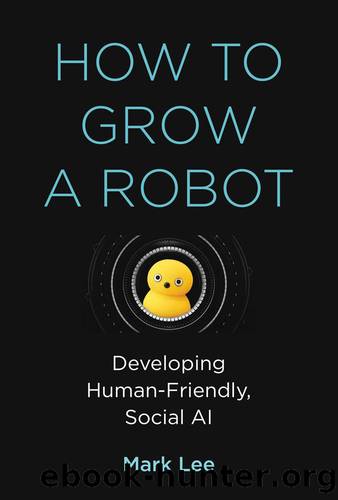
Author:Mark H. Lee; [Неизв.]
Language: eng
Format: epub
Tags: Developing robots; Social robots; General-purpose robots; General intelligence; Human and robot nature; Human and computer thinking; Ontogeny; Embodiment; Enaction; Symbol grounding; Self-awareness; Motivation; Play behaviour; Robot individuality; Trust and ethics; Integrity and transparency; Deep learning; Knowledge and common sense; Artificial intelligence; Artificial neural networks; Limitations of AI; Robotics research; Future threats; Goal learning; Mental simulation; Humanoid robots; End-to-end learning; Human brain simulation; Computer vision; Big data; Data mining
Publisher: MIT Press
MODERN CYBERNETICS
Nowadays, the word cybernetics has lost its original meaning. Despite being at the very heart of AI in the beginning, it gradually faded as a field of study and was overshadowed by AI. This came about partly because the topic eventually broadened and extended into areas such as economic and political systems, population models, and the social sciences generally. Topics such as âsystems thinkingâ emerged and extended into management and other soft-science applications. At the same time, the treatment of key mathematical concepts, such as feedback theory, communication theory, and artificial neurons, gradually migrated into the harder sciences, such as control theory, engineering, and also psychology.
Some cybernetic outposts existed in university departments. In Britain, these included Keele University, the University of Reading, Brunel University, Kingâs College London, the University of Bradford, and Bangor University. At Keele University, Donald Mackay founded the Department of Communication and Neuroscience in 1960. At the University of Reading in 1964, Professor P. B. Fellgett became the first professor of cybernetics in Britain. The department of cybernetics (and, later, engineering) at Reading taught cybernetic courses, several of which are still offered today, but a degree in cybernetics is no longer offered. It was a similar story across other universities worldwide. Although France and some other European countries still fly the flag, the word cybernetics has now been overtaken by terms with purely digital meanings (e.g., cyberspace) and has lost its original connection to biology.
Perhaps the most famous proponent of cybernetic ideas in recent years was one of the founding fathers of AI; Marvin Minsky. In 1970, Minsky co-founded and was the first director of the world-famous MIT AI Lab. Minsky, who died in 2016, might have denied any connection to cybernetics (he hardly ever mentioned the word in his writings), but he was often critical of the uses of formal logic and language in AI, and he had a biologically sympathetic outlook toward machines. Minsky didnât agree with purely symbolic systems, and his many interventions can be seen as steering AI toward models of biological and psychological phenomena that took a more holistic view of the problem. Informally, AI split into two camps: the âNeats,â led by John McCarthy, who promoted the crispness and elegance of logical formalisms; and the âScruffies,â led by Minsky, who were willing to recognize the messiness of biology. See Minsky (1991) to learn more about Minskyâs view on this topic.
A notable modern cybernetic development came from two Chileans, Humberto Maturana and Francisco Varela, who stressed the importance of living systems as the substrate for feedback mechanisms, and ultimately intelligence (Maturana and Varela, 1991). They created the term autopoiesis to refer to systems that can maintain themselves through cell renewal and other biochemical processes. This work is still inspirational for many, but it has been difficult to reconcile with, or translate into, conventional digital technology.
Download
This site does not store any files on its server. We only index and link to content provided by other sites. Please contact the content providers to delete copyright contents if any and email us, we'll remove relevant links or contents immediately.
Whiskies Galore by Ian Buxton(42193)
Introduction to Aircraft Design (Cambridge Aerospace Series) by John P. Fielding(33259)
Small Unmanned Fixed-wing Aircraft Design by Andrew J. Keane Andras Sobester James P. Scanlan & András Sóbester & James P. Scanlan(32884)
Aircraft Design of WWII: A Sketchbook by Lockheed Aircraft Corporation(32393)
Craft Beer for the Homebrewer by Michael Agnew(18373)
Turbulence by E. J. Noyes(8241)
The Complete Stick Figure Physics Tutorials by Allen Sarah(7490)
The Institute by Stephen King(7180)
The Thirst by Nesbo Jo(7170)
Kaplan MCAT General Chemistry Review by Kaplan(7076)
Bad Blood by John Carreyrou(6758)
Modelling of Convective Heat and Mass Transfer in Rotating Flows by Igor V. Shevchuk(6617)
Weapons of Math Destruction by Cathy O'Neil(6499)
Learning SQL by Alan Beaulieu(6412)
Man-made Catastrophes and Risk Information Concealment by Dmitry Chernov & Didier Sornette(6241)
Permanent Record by Edward Snowden(5974)
Digital Minimalism by Cal Newport;(5948)
Life 3.0: Being Human in the Age of Artificial Intelligence by Tegmark Max(5716)
iGen by Jean M. Twenge(5531)
